Monday, 16 March 2009
BeJUG jBPM Event Now Thursday In Ghent
Don't miss out on the next BeJUG event now thursday. Take this opportunity to connect with the core jBPM community developers!

Wednesday, 11 March 2009
Tuning jBPM In A Cluster
Szymon Zeslawski has posted a great TSS article: Scalability and Performance of jBPM Workflow Engine in a JBoss Cluster.
That is indeed the spot that we're working hard to resolve in jBPM 4: better tuning defaults and that way try to postpone the need for custom tuning when scaling out.
Awsome !
The verdict is that jBPM is a very efficient workflow engine, it only requires turning the right knobs in order to get the most out of it.
That is indeed the spot that we're working hard to resolve in jBPM 4: better tuning defaults and that way try to postpone the need for custom tuning when scaling out.
By adding 3 servers and tweaking jBPM configuration, we were able to increase the throughput over 16 times in comparison to 1 server environment with default setup.
Awsome !
Tuesday, 10 March 2009
Next jBPM Community Day is May8th in Antwerp, Belgium
It will be hard to match the Dublin jBPM Community Day from last year. But we sure are going to give it a good try an Antwerp. Mark May 8th in your calendar, start to book your flights and get some rest upfront.
More details in this wiki page
More details in this wiki page
Thursday, 30 October 2008
3 Approaches To Transform Analysis Diagrams Into Executable Processes
Finally a good blog discussion related to the reason of existence for Business Process Management (BPM). It's about how analysis diagrams get transformed into executable processes.
Scott Francis' post Compliance for the BPMN Specification… Shooting the Moon? already gives real good comments on the recent blogs. That is what triggered me to put the approaches that I know of in a list.
When considering BPM as a management discipline, the goal is that the business people should be in control. So business people, which usually don't have a lot of software development skills, create diagrams to document how people and systems work together. These I'll refer to as analysis diagrams. In this context, BPMN is currently getting a lot of attention.
On the other hand, it might be decided that software support for these processes will be developed. In that context, an executable process is a piece of software that can be executed on a BPM System (BPMS) and which also has a graphical representation. The only real executable process language standard currently around is BPEL. But BPEL targets what I describe as a completely different use case, namely service orchestration.
That brings us to the obvious question of how are analysis diagrams different from executable processes and how to bridge between them. This is where *finally* an interesting debate is starting at the heart of BPM.
Here are the 3 approaches:
1) I'll start with our own approach, as of course, that is the best :-)
We believe that analysis diagrams can be created in many notations, BPMN being one of them. Then it is up to the IT department to select the best process language that fits with their needs and then produce an executable process that looks exactly like the analysis diagram. That way the diagram remains an excellent instrument in the communication between IT and business people. But as an executable process is actually software, it should te governed by the IT department. In a previous post about BPMN 2.0 I elaborate a bit more on how we see the collaboration between analysts and developers.
This approach is quite similar to those who claim that we should move to executable BPMN. BPMN 2.0 will most likely incorporate explicit execution semantics for all the diagram elements. I believe that this is a very pragmatic move by Oracle and IBM as they have BPEL products and pure-play BPM products in their portfolio. For the pure-play BPM products, the executable BPMN route basically puts the translation to an executable process under the hood and makes it therefor irrelevant. That way, the pure-play BPM vendors are not forced to use BPEL underneith as the mapping between BPMN and BPEL is basically broken.
But in our view, a naive adoption of making BPMN executable can easily lead to trouble. It's generally accepted that process diagrams need to be decorated with technical details before they can be executed on a BPMS. Most of thos technical details that do not translate to the business side.
But the same is true the other way round: be very careful with expressing too much business level details in the diagram as they might not translate to the executable process. So you want to keep those out of sight of the business analyst. In many cases a lot of those graphical notation bells and whistles are actually technical details. So if the naive way of making BPMN executable results into graphical programming, then it is not suited to support BPM as a management discipline. Business analysts should be able to model freely without being constrained by technical details.
So in conclusion, the primary focus of bridging between analysis diagrams and executable processes should revolve around just the basic boxes and arrows. That is the intersection that can facilitate communication between business and IT.
2) Another approach is roundtripping. As said above, most people have realized that this is basically broken... unless... You can develop so much tooling around it like Oracle or IBM. With a vast amount of tooling a BPMN diagram can be translated to an executable process in e.g. BPEL and then synchronization links can be maintained so that roundtripping becomes an option.
The downside of this is that the user actually has to maintain the synchronization links. A lot of effort will be spend by the developer team to feed in the synchronization information. And still the changes that are generated to the executable process when a business analyst updates the analysis diagram, will never be transparant. In most cases. the development team will still have to intervene and merge the changes and verify the interactions between the process and verify the correct operation of the process in the context of other related software components.
And IMO, some teams might spend the time to maintain 2 models and keep them synchronized, but in general, I think this is undermining a big part of the agility value of BPM.
3) The third approach I'll discuss here is expressed by Ismael Ghalimi in Why BPEL Matters.
In their approach comes down to mapping BPMN to BPEL. But he also adds that the resulting BPEL process should be considered as the bytecode.
In this approach there is a believe that an analyst diagram can be decorated with technical details to make it executable. I don't see yet how this can lead to anything else then graphical programming.
I'm really puzzled by this approach as it seems to me that it is taking the worst of two worlds. On the one hand, they create a hard link between the analysis diagram and the executable diagram which blocks the analyst from modeling freely. And secondly, why would you perform a clumsy translation to BPEL if it's kept under the hood? I could think of easier ways to execute BPMN natively then through a translation to BPEL.
If BPEL should remain under the hood, then I don't get why BPEL is so important? I agree with the standardization argument. But they are also building SimPEL, which he describes as a different syntax for BPEL.
Another point that I wish to challenge is that BPEL supports distributed transactions. Afaict, BPEL doesn't specify when the state of a process should be persisted and it doesn't state how that persistence should participate in a transaction, let alone how it should participate in a distributed transaction that spans multiple systems.
Let me know if I'm missing something.
Scott Francis' post Compliance for the BPMN Specification… Shooting the Moon? already gives real good comments on the recent blogs. That is what triggered me to put the approaches that I know of in a list.
When considering BPM as a management discipline, the goal is that the business people should be in control. So business people, which usually don't have a lot of software development skills, create diagrams to document how people and systems work together. These I'll refer to as analysis diagrams. In this context, BPMN is currently getting a lot of attention.
On the other hand, it might be decided that software support for these processes will be developed. In that context, an executable process is a piece of software that can be executed on a BPM System (BPMS) and which also has a graphical representation. The only real executable process language standard currently around is BPEL. But BPEL targets what I describe as a completely different use case, namely service orchestration.
That brings us to the obvious question of how are analysis diagrams different from executable processes and how to bridge between them. This is where *finally* an interesting debate is starting at the heart of BPM.
Here are the 3 approaches:
1) I'll start with our own approach, as of course, that is the best :-)
We believe that analysis diagrams can be created in many notations, BPMN being one of them. Then it is up to the IT department to select the best process language that fits with their needs and then produce an executable process that looks exactly like the analysis diagram. That way the diagram remains an excellent instrument in the communication between IT and business people. But as an executable process is actually software, it should te governed by the IT department. In a previous post about BPMN 2.0 I elaborate a bit more on how we see the collaboration between analysts and developers.
This approach is quite similar to those who claim that we should move to executable BPMN. BPMN 2.0 will most likely incorporate explicit execution semantics for all the diagram elements. I believe that this is a very pragmatic move by Oracle and IBM as they have BPEL products and pure-play BPM products in their portfolio. For the pure-play BPM products, the executable BPMN route basically puts the translation to an executable process under the hood and makes it therefor irrelevant. That way, the pure-play BPM vendors are not forced to use BPEL underneith as the mapping between BPMN and BPEL is basically broken.
But in our view, a naive adoption of making BPMN executable can easily lead to trouble. It's generally accepted that process diagrams need to be decorated with technical details before they can be executed on a BPMS. Most of thos technical details that do not translate to the business side.
But the same is true the other way round: be very careful with expressing too much business level details in the diagram as they might not translate to the executable process. So you want to keep those out of sight of the business analyst. In many cases a lot of those graphical notation bells and whistles are actually technical details. So if the naive way of making BPMN executable results into graphical programming, then it is not suited to support BPM as a management discipline. Business analysts should be able to model freely without being constrained by technical details.
So in conclusion, the primary focus of bridging between analysis diagrams and executable processes should revolve around just the basic boxes and arrows. That is the intersection that can facilitate communication between business and IT.
2) Another approach is roundtripping. As said above, most people have realized that this is basically broken... unless... You can develop so much tooling around it like Oracle or IBM. With a vast amount of tooling a BPMN diagram can be translated to an executable process in e.g. BPEL and then synchronization links can be maintained so that roundtripping becomes an option.
The downside of this is that the user actually has to maintain the synchronization links. A lot of effort will be spend by the developer team to feed in the synchronization information. And still the changes that are generated to the executable process when a business analyst updates the analysis diagram, will never be transparant. In most cases. the development team will still have to intervene and merge the changes and verify the interactions between the process and verify the correct operation of the process in the context of other related software components.
And IMO, some teams might spend the time to maintain 2 models and keep them synchronized, but in general, I think this is undermining a big part of the agility value of BPM.
3) The third approach I'll discuss here is expressed by Ismael Ghalimi in Why BPEL Matters.
In their approach comes down to mapping BPMN to BPEL. But he also adds that the resulting BPEL process should be considered as the bytecode.
In this approach there is a believe that an analyst diagram can be decorated with technical details to make it executable. I don't see yet how this can lead to anything else then graphical programming.
I'm really puzzled by this approach as it seems to me that it is taking the worst of two worlds. On the one hand, they create a hard link between the analysis diagram and the executable diagram which blocks the analyst from modeling freely. And secondly, why would you perform a clumsy translation to BPEL if it's kept under the hood? I could think of easier ways to execute BPMN natively then through a translation to BPEL.
If BPEL should remain under the hood, then I don't get why BPEL is so important? I agree with the standardization argument. But they are also building SimPEL, which he describes as a different syntax for BPEL.
Another point that I wish to challenge is that BPEL supports distributed transactions. Afaict, BPEL doesn't specify when the state of a process should be persisted and it doesn't state how that persistence should participate in a transaction, let alone how it should participate in a distributed transaction that spans multiple systems.
Let me know if I'm missing something.
Friday, 24 October 2008
3 BPM Blogs You Want To Subscribe To
Here are some top notch blogs that I have *have* to recommend:
1) Leadership BPM by Rashid N. Khan
Last year, Rashid retired as the CEO of Ultimus and now he started a blog in which he shares his vast amount of experience.
In What it will take to deliver BPM as SaaS?, he already seems to pinpoint the crucial conditions of the latest BPM as a service hype.
What's cool for me is that when I started jBPM, Ultimus is actually the first product I looked at to see what the competition was like.
2) Small steps with big feet by Joram Barrez
Joram is a BPM and jBPM guru that I had the opportunity to collaborate with on a few occasions. For all your jBPM performance concerns, make sure you read his blog or get him involved. He tweaked jBPM performance better then we did !
His latest blog Blogs about jBPM you don’t want to miss! provides links to a lot of interesting jBPM related posts that are very informative.
3) PlanetjBPM by Ronald van Kuijk (aka kukeltje)
Ronald provides great practical tips and tricks on jBPM. He's another BPM and jBPM guru calling himself rightfully the jBPM Forum Addict. In practice this means that he helped thousands of people getting started with jBPM over the last 5 years by answering basically every question on the jBPM user forum.
1) Leadership BPM by Rashid N. Khan
Last year, Rashid retired as the CEO of Ultimus and now he started a blog in which he shares his vast amount of experience.
During this period I was involved in 100s of BPM deployments worldwide and collected a wealth of experience. Now that I have retired from Ultimus, I want to leverage this expeience and help senior executives to learn about and benefit from BPM and related technologies. I have a unique perspective and I have been very focused on the practical, nuts-and-bolts issues about BPM that senior executives have to understand if they are going to fully realize the potential of BPM.The nice thing is that he now can give an independent, unconstrained look on things. Opinions of that skill and which can speek freely are hard to find.
In What it will take to deliver BPM as SaaS?, he already seems to pinpoint the crucial conditions of the latest BPM as a service hype.
In my judgment BPM SaaS has to have the following characteristics as a minimum. First, it must have the ability to model and modify executable processes in a hosted application. The ability to design executable processes, in contrast to simple flow diagram, is pretty challenging. ... Second, BPM SaaS must have the ability to allow customers to integrate with their inside-the-firewall data and other applications. This is crucial because BPM deals with company’s data and interacts with other applications. Without effective integration only the very simplistic BPM processes are candidates for SaaS, and CxOs are reluctant to invest money or mindshare on simplistic processes. Integration is the Achille’s heel of BPM SaaS and solutions for this will evolve only gradually. Perhaps the best approach for BPM vendors is the emerging class of "application appliances" that leverage virtualization technology to deliver inside-the-firewall solutions on a SaaS basis. This has the potential of solving the integration problem. I will discuss it in another blog as this is a topic on its own. Third, and easiest, is the ability for end-users to participate in business processes using a browser. ... Fourth, BPM SaaS must provide a means for customers to monitor and administer their processes over the Internet. Again, with the emergence of AJAX and RIAs, this is not a challenging obstacle. And fifth, BPM SaaS must provide some web-based reporting, BI and BAM capabilities.In Is the BPM Industry stuck in no-man’s land?, Rashid starts by pointing out that BPM systems didn't get to the mainstream as they always envisioned:
Even if I take a conservative forecast and assume that the market was $1 billion in 1998 and growing at 15% per annum, it should be at least $4 billion today. But the most recent forecast continue to put it in the $2 billion range. So where does all the growth fizzle away? Second, every BPM vendor and analyst can provide a number of actual case studies of BPM deployments that demonstrate remarkable ROI and productivity benefits. And it is relatively easy for senior management to understand why BPM can deliver such results. Yet the penetration of BPM in organizations is still small and I would venture to say that less than 10% of processes are automated despite all the ROI and productivity proof points. Third, every year BPM vendors claim impressive growth and publish a roster of new customers. Yet most pure-play BPM vendors are relatively small companies and none have been able to go public despite the claims of growth and the fact that many of them have raised tens of millions of dollars in venture capital.This is exactly what I thought as well and in my opinion this is largely due to the fact that executable processes should be part of the software applications themselves. The big problem still to date is that BPM Systems are considered as monolithic applications that are hard to integrate into a software development project. That is exactly the problem that we have focussed on in jBPM since the very beginning. And indeed it is not an easy one. Rashid seems to come to a similar conclusion:
First, BPM sounds glamorous, but it is not easy. This is because human beings work in extremely complex ways. Developing software that caters to all these ways is not easy. The “human interface” of BPM is complex and challenging. Second, the IT environments in which BPM has to thrive are very complex, varied and in constant flux. BPM cannot be successful without seamless integration with the rest of the IT infrastructure.I hope that Rashid keeps up sharing his points of view.
What's cool for me is that when I started jBPM, Ultimus is actually the first product I looked at to see what the competition was like.
2) Small steps with big feet by Joram Barrez
Joram is a BPM and jBPM guru that I had the opportunity to collaborate with on a few occasions. For all your jBPM performance concerns, make sure you read his blog or get him involved. He tweaked jBPM performance better then we did !
His latest blog Blogs about jBPM you don’t want to miss! provides links to a lot of interesting jBPM related posts that are very informative.
3) PlanetjBPM by Ronald van Kuijk (aka kukeltje)
Ronald provides great practical tips and tricks on jBPM. He's another BPM and jBPM guru calling himself rightfully the jBPM Forum Addict. In practice this means that he helped thousands of people getting started with jBPM over the last 5 years by answering basically every question on the jBPM user forum.
Thursday, 23 October 2008
BPEL versus BPM
Pierre Vigneras wrote a nice article on InfoQ about how BPEL is not the right solution for BPM. As you might know that is what I have been saying for a long time. Also the discussion that follows the article is quite interesting.
Tuesday, 21 October 2008
Seven Forms Of BPM
My article Seven Forms Of BPM with JBoss jBPM just got published on dzone. In this article, I explain 7 distinct concrete forms of BPM. Some are more business oriented and some are more technical oriented. BPM is a hugely overloaded term, resulting in a lot of confusion. Hopefully this article helps to clear out at least some of the confusion.
If you don't like clicking your way through the pages, consider the printer friendly format of the article.
If you don't like clicking your way through the pages, consider the printer friendly format of the article.
Wednesday, 25 June 2008
How Are Services, Data And Processes Tied Up in an SOA?
After reading InfoQ's report on Fred Cummins' essay about the data in an SOA, I thought the discussion could get a lot more concrete if we added an overview picture in the mix. Here's my take on how applications, services, data and processes are related.
Please ignore my absent taste for colour and drawing skills :-)
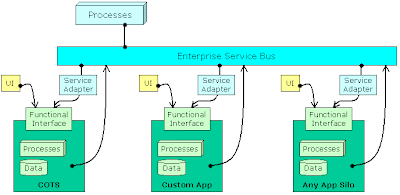 Applications and functionality is typically developed in application silos. Sometimes they come as Commercial Off The Shelf (COTS) products, sometimes they are custom build applications. Fred touches on an interesting topic with
An application silo usually manages data and it includes support for the related business processes. These processes can be implemented by an embeddable BPMS or they can be just as well coded in a programming language. These processes can have all the characteristics of processes implemented on top of the ESB in e.g. BPEL. They are long running and transactional, they can include human tasks as well as service invocations to services on the bus and so on. Application silo processes are only distinct from the processes on top of the ESB in the sense that they are an integral part of the application silo and therefore they are hosted in a different environment like e.g. Java instead of XML/WSDL. That is where the value of the jPDL process language comes in. It's really embeddable and it integrates very nice with any Java environment. That's why jPDL is embedded a lot in Java based portals, Enterprise Content Management (ECM) systems and custom Java applications. It's really fit for this tight coupled Java environment.
Each of these application silo's typically has a functional interface that exposes the operations supported by the application. A User Interface (UI) can then expose the functional interface to users and the same functional interface can also be exposed to the Enterprise Service Bus (ESB) via a Service Adapter.
The main purpose of an Enterprise Service Bus is integrating disparate systems. So it's typically XML/WSDL based. If many events and service invocations are published on the ESB related to one business process, then it might make sense to track the overall process with an ESB-level process. BPEL is the ideal process language for this environment.
What not a lot of people realize is that the location of business process implementations can be freely picked. If most of the accessed functionality and data for a given process is related to one application silo, it might make much more sense to implement it inside of that application silo. Still in that scenario, services can be consumed from other systems over the ESB.
On the other hand, if the process must integrate with many disparate systems, most of the events are already published on the ESB and there is no application to which this process clearly belongs, then it's most likely easier to implement it as a BPEL process on top of the ESB.
The main point I have tried to make is that the implementation of Business Processes should not be tied to integration technologies (read: the ESB). They can be just as well located within the application silos.
This also exposes one of the difficulties in mapping the analyst's business processes to implementation level processes. Analysts draw boxes and arrows in a diagram and they are not really concerned with this architectural background that provides the environment for implementing those processes. So an analysis process still has to be mapped to executable process languages in application silo's or on top of the ESB. This is not always a one-to-one mapping.
Please ignore my absent taste for colour and drawing skills :-)
 Applications and functionality is typically developed in application silos. Sometimes they come as Commercial Off The Shelf (COTS) products, sometimes they are custom build applications. Fred touches on an interesting topic with
"Since the increased focus on integration technologies and SOA, there is a common misconception that tight coupling is bad. For integrating disparate systems, that is typically true. But inside of application silo's tight coupling is typically a good thing.
Those who focus on data management have, for decades, driven the industry toward consolidation of databases under a philosophy that tighter coupling means greater efficiency and consistency.
"
An application silo usually manages data and it includes support for the related business processes. These processes can be implemented by an embeddable BPMS or they can be just as well coded in a programming language. These processes can have all the characteristics of processes implemented on top of the ESB in e.g. BPEL. They are long running and transactional, they can include human tasks as well as service invocations to services on the bus and so on. Application silo processes are only distinct from the processes on top of the ESB in the sense that they are an integral part of the application silo and therefore they are hosted in a different environment like e.g. Java instead of XML/WSDL. That is where the value of the jPDL process language comes in. It's really embeddable and it integrates very nice with any Java environment. That's why jPDL is embedded a lot in Java based portals, Enterprise Content Management (ECM) systems and custom Java applications. It's really fit for this tight coupled Java environment.
Each of these application silo's typically has a functional interface that exposes the operations supported by the application. A User Interface (UI) can then expose the functional interface to users and the same functional interface can also be exposed to the Enterprise Service Bus (ESB) via a Service Adapter.
The main purpose of an Enterprise Service Bus is integrating disparate systems. So it's typically XML/WSDL based. If many events and service invocations are published on the ESB related to one business process, then it might make sense to track the overall process with an ESB-level process. BPEL is the ideal process language for this environment.
What not a lot of people realize is that the location of business process implementations can be freely picked. If most of the accessed functionality and data for a given process is related to one application silo, it might make much more sense to implement it inside of that application silo. Still in that scenario, services can be consumed from other systems over the ESB.
On the other hand, if the process must integrate with many disparate systems, most of the events are already published on the ESB and there is no application to which this process clearly belongs, then it's most likely easier to implement it as a BPEL process on top of the ESB.
The main point I have tried to make is that the implementation of Business Processes should not be tied to integration technologies (read: the ESB). They can be just as well located within the application silos.
This also exposes one of the difficulties in mapping the analyst's business processes to implementation level processes. Analysts draw boxes and arrows in a diagram and they are not really concerned with this architectural background that provides the environment for implementing those processes. So an analysis process still has to be mapped to executable process languages in application silo's or on top of the ESB. This is not always a one-to-one mapping.
Thursday, 12 June 2008
Task Assignment And Pools Harder Then You Think
Workflows and business processes are often perceived as simple in the sense that non technical people can draw diagrams that can be executed. John Reynolds explain a typical example of task assignment in Getting tasks to the right participants - Part 1:
The second post that I refer to is Bruce Silver's BPMN to Requester: Get Outta My Pool. In that post, Bruce points out that BPMN swimlanes are in fact inspired by BPEL's partner links and that experienced business analyst have a hard time understanding those basics. In fact, I think the business analysts are right. Analyst models should not be constrained with executable details. If we want to create a notation that can serve analysts and process developers, then it should be nothing more but boxes and arrows. All the extra semantics that are added to diagrams only are targetted to either the analysts or to the developer. But those extra semantical decorations and concepts never make (the same) sense to both target audiences.
This really shows the scheziphrenic nature of BPMN. On the one hand BPMN aims to be a free modelling notation for business analysts. And on the other hand, it tries to map one on one to an executable service orchestration language like BPEL.
“When a Loan Application comes in, make the application available to all of our Credit Officers who have sufficient Lending Authority to process the loan, and who haven’t already met their quota of applications for the week. Of course if everybody has already met their quotas for the week, then let everyone have an opportunity to work on the new application.One more thing, only a few of our Credit Officers can approve loans over $100,000, so don’t route low value loans to them unless they are the only available credit officers.
And don’t let anyone claim more than 3 applications at a time. Our Credit Officers are compensated for the number of loans that they process, and some of them will claim all the applications that they can in hopes of earning more money.”
This really sounds like a realistic task assignment to me. My point here is that it's impossible to capture this kind of logic in the business process diagram. It reinforces the message about process development that I've been giving for a long time. Analysts provide a description of a business process. Typically that is a diagram plus free text documentation like e.g. this kind of task assignment rules. Then it is up to the process developer to come up with an executable process that looks exactly like the business analyst's diagram, but this time it is an executable process. Iterative development can then be realised on the executable process. I don't believe that round tripping between analyst and implementation models is feasible for the majority of BPM use cases, especially if those turn out to be very different.
The second post that I refer to is Bruce Silver's BPMN to Requester: Get Outta My Pool. In that post, Bruce points out that BPMN swimlanes are in fact inspired by BPEL's partner links and that experienced business analyst have a hard time understanding those basics. In fact, I think the business analysts are right. Analyst models should not be constrained with executable details. If we want to create a notation that can serve analysts and process developers, then it should be nothing more but boxes and arrows. All the extra semantics that are added to diagrams only are targetted to either the analysts or to the developer. But those extra semantical decorations and concepts never make (the same) sense to both target audiences.
This really shows the scheziphrenic nature of BPMN. On the one hand BPMN aims to be a free modelling notation for business analysts. And on the other hand, it tries to map one on one to an executable service orchestration language like BPEL.
Monday, 9 June 2008
Brewing The jBPM Community
Our managers were a bit concerned at first. "Are you sure it's a good idea to have an IT event in a beer factory?". Of course it is...
Last Friday, we had the jBPM Community Day. A rememberable day it turned out to be. We assembled the full core of the jBPM contributors from JBoss and other companies at the Guinness storehouse in Dublin. More then 40 people showed up, of which half of them flew in specially for this event.
The three muscateers arrived. The first thing they noticed was this thing that looked like a spaceship mounted on top of the beer factory.
 Finding the way to the room took some concentration.
 But most of us made it before the Master of Ceremony kicked it off.
 We gave most of the platform for talks to core members of the community. That turned out to be a bulls eye.
Joram Barrez started addressed any performance question that people in the audience might wonder about. Also he showed the value of how easy the Business Intelligence information could be extracted from jBPM process executions.
Next, Mark Proctor managed to sneek in a Drools-spy into our jBPM event.
 Paul Browne talked about the situations where drools rules and jPDL processes make a perfect match. Both Joram and Paul are great speakers and they know what they talk about. Thanks a lot, guys!
Then it was time to do some sightseeing in the building.
 And to taste the Guinness at the gravity bar (the space ship thing).
 An awsome, full 360 degrees view!
 After that pint of Guinness, my short talk was scheduled. Next time we need to have someone that pulls the plug when I go over my time limit again :-)
Then we splitted the audience in two separate tracks. The core contributors went to discuss the future of the project.
 Ronald (aka Kukeltje) showed how to hold a Guinness so that your neighbour doesn't see it and with the other hand answering forum questions at the same time.
On a more serious note: this is where the most constructive feedback was generated. We had a great brainstorm session on how we can improve the migration path from jPDL 3 to the upcoming jPDL 4.
At the same time, the other people users got an introduction to jPDL from Koen Aers, the creator of the jPDL eclipse plugin designer.
The reception dinner closed a fruitful day.
 Then we went down to the temple bar area and the Master of Ceremony found this great pub with live music.
 But with strickt rules !
 The 2BInternational team met with the locals and showed us that they had more moves then only in Business Process Management.
 But then things started to get messy.
 So I concluded it was time to stop taking pictures :-)
Oh... and there was a memorable close of this memorable evening. When walking to the hotel, I came across this die hard artist still out on the street doing a perfect inpersonation of Mark Proctor. Awsome!
 Amen.
Amen.
Last Friday, we had the jBPM Community Day. A rememberable day it turned out to be. We assembled the full core of the jBPM contributors from JBoss and other companies at the Guinness storehouse in Dublin. More then 40 people showed up, of which half of them flew in specially for this event.
The three muscateers arrived. The first thing they noticed was this thing that looked like a spaceship mounted on top of the beer factory.
 Finding the way to the room took some concentration.
 But most of us made it before the Master of Ceremony kicked it off.
 We gave most of the platform for talks to core members of the community. That turned out to be a bulls eye.
Joram Barrez started addressed any performance question that people in the audience might wonder about. Also he showed the value of how easy the Business Intelligence information could be extracted from jBPM process executions.
Next, Mark Proctor managed to sneek in a Drools-spy into our jBPM event.
 Paul Browne talked about the situations where drools rules and jPDL processes make a perfect match. Both Joram and Paul are great speakers and they know what they talk about. Thanks a lot, guys!
Then it was time to do some sightseeing in the building.
 And to taste the Guinness at the gravity bar (the space ship thing).
 An awsome, full 360 degrees view!
 After that pint of Guinness, my short talk was scheduled. Next time we need to have someone that pulls the plug when I go over my time limit again :-)
Then we splitted the audience in two separate tracks. The core contributors went to discuss the future of the project.
 Ronald (aka Kukeltje) showed how to hold a Guinness so that your neighbour doesn't see it and with the other hand answering forum questions at the same time.
On a more serious note: this is where the most constructive feedback was generated. We had a great brainstorm session on how we can improve the migration path from jPDL 3 to the upcoming jPDL 4.
At the same time, the other people users got an introduction to jPDL from Koen Aers, the creator of the jPDL eclipse plugin designer.
The reception dinner closed a fruitful day.
 Then we went down to the temple bar area and the Master of Ceremony found this great pub with live music.
 But with strickt rules !
 The 2BInternational team met with the locals and showed us that they had more moves then only in Business Process Management.
 But then things started to get messy.
 So I concluded it was time to stop taking pictures :-)
Oh... and there was a memorable close of this memorable evening. When walking to the hotel, I came across this die hard artist still out on the street doing a perfect inpersonation of Mark Proctor. Awsome!
 Amen.
Amen.
Tuesday, 20 May 2008
High-Quality Free BPM Book
Thanks to Sandy Kemsley, I found Michael Zur Muehlen has published his very nice e-book online. No registration required so definitely have a look at it. Even though the book seems to be a couple of years old, it includes a thoughtful and still very relevant description of BPM as a discipline and the relation to BPM software technology.
Friday, 16 May 2008
Dublin, Here We Come !
The jBPM Community Day on June 6th is starting to become a real international event with people coming from Belgium, The Netherlands, France, Germany, Italy and Ireland of course.
The program is updated and gives a good idea of what's going to happen. Also a list of hotels and activities is added (thanks, Paul!)
Don't miss it ! Be sure to registration quickly. It is as easy as sending an email to dublin@jbpm.org
The program is updated and gives a good idea of what's going to happen. Also a list of hotels and activities is added (thanks, Paul!)
Don't miss it ! Be sure to registration quickly. It is as easy as sending an email to dublin@jbpm.org
Wednesday, 7 May 2008
BPM != BPEL
It seems to be a very stubbern misunderstanding that I have tried to straighten out many times before. But for those that didn't get it yet, even John Evdemon, co-chair of the BPEL technical committee said already in 2007 that BPM != BPEL and now in the recent BPMN discussion he adds: If you can do something it doesn't mean that you should...
HTH
HTH
Monday, 5 May 2008
Buzzwords In Pictures
Sometimes you can find good explanations of tech buzzwords in real life. So far, I found out what Ajax, SOA and backup really means.
If your HTML-over-HTTP-house is on fire, the Ajax hose comes to the rescue.

If your integration stinks like a sewage system, just put a SOA cover on it.

And a backup is even more vital then I ever imagined.
 I'll translate for the non-dutch speaking: "Even mother nature provides a back-up" And in the round circle it says : "Test one month for free". Sign me up ! Sign me up !
If your HTML-over-HTTP-house is on fire, the Ajax hose comes to the rescue.

If your integration stinks like a sewage system, just put a SOA cover on it.

And a backup is even more vital then I ever imagined.
 I'll translate for the non-dutch speaking: "Even mother nature provides a back-up" And in the round circle it says : "Test one month for free". Sign me up ! Sign me up !
Big Problems Ahead For BPMN 2.0 ?
Boris Lublinsky posted a good overview on InfoQ about the online discussions around BPMN 2.0 and it reveals IMO a very profound problem in traditional BPM thinking.
One group wants to give the graphical process modelling notation executable semantics. In that case, a BPMN 2.0 diagram would specify exact (and hopefully portable) semantics and it can be executed on a computer system. On the other hand, some people raise concerns about the simplicity in that approach.
This again shows that today the dual nature of BPM is not enough recognized by BPM vendors. BPM tries to make the bridge between non technical business analysts and the implementation of a business process.
A business process analyis can contain a diagram and it expresses how people and systems work together. Such an analysis is targetted at other people so it can include free text and a diagram. It's description of how things work in the real world. Analysis can be done without even automation. An analysis is always an important input to express the requirements for the automation of a business process. Some analysts use very expressive diagram notations, while others just use boxes and arrows. But even in case a lot of details are expressed in the diagram, they are not necessarily expressing runtime execution semantics in the software sense of the word.

In case a business process is automated with a Business Process Management System (BPMS) , an executable process needs to be created. An executable process serves as input to a BPMS, after which it will be able to execute the process. Executing a process by a BPMS means a combination of monitoring progress and performing automated tasks. Executable processes can also be based around a diagram. But in this case, the diagram is a projection of a software artifact. The executable process will in most cases contain technical details outside the scope of the diagram. Whatever way you look at it, an executable process is software.
There are some aspects that cause some fog around this clear picture. In practice, it turns out that the roles are not that clearly separated. In fact, a lot of business analysts have technical knowledge so they already are able to think in terms of what it means to execute the software. Also, there are different levels of process languages. The more a executable process language targets to be general purpose, the more complex it will be and the more technical it will become.
If a diagram notation (like BPMN) wants to be used for both the analysis as well as the executable process diagram, it should limit the number of details that can be expressed. As analysis details don't match with technical details necessary for making the process executable. The more details that are exposed in the graphical notation, the conflicts will arise because of this dual nature of the process diagram.
More and more vendors start to see that the gap between the analysis process and the executable process can not just be eliminated. But still quite a few target round tripping, which means that the analysis model is kept in sync with the executable model. I have seen multiple vendors come out with features that support this. Still I think that is a waiste of time. Building tools that synchronize automagically between the analysis and the executable diagram is too hard. Using those tools effectively will only succeed in environments with a lot of discipline cause changes in the executable process will often require an analyst to incorporate those changes into the analysis diagram. Furthermore, those tools impose too much assumptions on the analysis language and the executable process language. FWIW, such an approach never did fly with UML Class Diagrams, and I don't see how the situation is different for processes. In fact, in case of UML class diagrams, no-one even thought of automagically synchronizing the analysis class model with the executable classes.
Instead, I think it is much more practical to create an executable process language that can build the executable details around a given diagram structure. That way, the executable process diagram will be very similar to the analysis diagram. The better the executable process, the less the diagram will have to change. But a conversion step cannot just be eliminated. Even if the executable process languages was 'perfect' in keeping the same diagram, some parts in the analysis diagram might not even be automated.
Once a business process gets automated, the diagram in the analysis document can be replaced with the executable process diagram. This has as a consequence that the analysis diagram becomes read-only for the analysts once it has been converted to an executable process.
Instead of embracing the dual nature of BPM, the InfoQ post outlines very well how two opposite camps have formed around analysis and implementation. Previously the focus of BPMN was on analysis only. It's much easier to reach consensus in that more limited scope. Now, the big vendors got involved and expressed a clear vision to make BPMN executable. That opens up the whole discussion of the environment. BPEL clearly chose for an ESB environment based on WSDL. But (just to give another example) jPDL is defined in a Java environment. I don't yet see how you can define an executable process language without selecting a concrete environment in which it operates. This is exactly why we support multiple process languages on our Process Virtual Machine.
The way things are moving now, the move towards executability of BPMN is starting to become clear. But looking further in that direction, I can only see quicksand. As indicated above, the vision of making BPMN executable could quickly be dragged down by many technical "details". It will be interesting to see how that is going to play out, but my fear is that it's not gonna be a smooth ride.
One thing puzzles me, though. Why is everyone talking about a new file format for BPMN 2.0, while there is XPDL ? The WfMC guys did a lot of effort to get XPDL synced up with BPMN and they made a lot of noise about it, so it cannot be an oversight. Still everyone seems to be silent about the possibility of using XPDL as the file format. Does anyone know more about the motivations for this silence ?
One group wants to give the graphical process modelling notation executable semantics. In that case, a BPMN 2.0 diagram would specify exact (and hopefully portable) semantics and it can be executed on a computer system. On the other hand, some people raise concerns about the simplicity in that approach.
This again shows that today the dual nature of BPM is not enough recognized by BPM vendors. BPM tries to make the bridge between non technical business analysts and the implementation of a business process.

A business process analyis can contain a diagram and it expresses how people and systems work together. Such an analysis is targetted at other people so it can include free text and a diagram. It's description of how things work in the real world. Analysis can be done without even automation. An analysis is always an important input to express the requirements for the automation of a business process. Some analysts use very expressive diagram notations, while others just use boxes and arrows. But even in case a lot of details are expressed in the diagram, they are not necessarily expressing runtime execution semantics in the software sense of the word.

In case a business process is automated with a Business Process Management System (BPMS) , an executable process needs to be created. An executable process serves as input to a BPMS, after which it will be able to execute the process. Executing a process by a BPMS means a combination of monitoring progress and performing automated tasks. Executable processes can also be based around a diagram. But in this case, the diagram is a projection of a software artifact. The executable process will in most cases contain technical details outside the scope of the diagram. Whatever way you look at it, an executable process is software.
There are some aspects that cause some fog around this clear picture. In practice, it turns out that the roles are not that clearly separated. In fact, a lot of business analysts have technical knowledge so they already are able to think in terms of what it means to execute the software. Also, there are different levels of process languages. The more a executable process language targets to be general purpose, the more complex it will be and the more technical it will become.
If a diagram notation (like BPMN) wants to be used for both the analysis as well as the executable process diagram, it should limit the number of details that can be expressed. As analysis details don't match with technical details necessary for making the process executable. The more details that are exposed in the graphical notation, the conflicts will arise because of this dual nature of the process diagram.
More and more vendors start to see that the gap between the analysis process and the executable process can not just be eliminated. But still quite a few target round tripping, which means that the analysis model is kept in sync with the executable model. I have seen multiple vendors come out with features that support this. Still I think that is a waiste of time. Building tools that synchronize automagically between the analysis and the executable diagram is too hard. Using those tools effectively will only succeed in environments with a lot of discipline cause changes in the executable process will often require an analyst to incorporate those changes into the analysis diagram. Furthermore, those tools impose too much assumptions on the analysis language and the executable process language. FWIW, such an approach never did fly with UML Class Diagrams, and I don't see how the situation is different for processes. In fact, in case of UML class diagrams, no-one even thought of automagically synchronizing the analysis class model with the executable classes.
Instead, I think it is much more practical to create an executable process language that can build the executable details around a given diagram structure. That way, the executable process diagram will be very similar to the analysis diagram. The better the executable process, the less the diagram will have to change. But a conversion step cannot just be eliminated. Even if the executable process languages was 'perfect' in keeping the same diagram, some parts in the analysis diagram might not even be automated.
Once a business process gets automated, the diagram in the analysis document can be replaced with the executable process diagram. This has as a consequence that the analysis diagram becomes read-only for the analysts once it has been converted to an executable process.
Instead of embracing the dual nature of BPM, the InfoQ post outlines very well how two opposite camps have formed around analysis and implementation. Previously the focus of BPMN was on analysis only. It's much easier to reach consensus in that more limited scope. Now, the big vendors got involved and expressed a clear vision to make BPMN executable. That opens up the whole discussion of the environment. BPEL clearly chose for an ESB environment based on WSDL. But (just to give another example) jPDL is defined in a Java environment. I don't yet see how you can define an executable process language without selecting a concrete environment in which it operates. This is exactly why we support multiple process languages on our Process Virtual Machine.
The way things are moving now, the move towards executability of BPMN is starting to become clear. But looking further in that direction, I can only see quicksand. As indicated above, the vision of making BPMN executable could quickly be dragged down by many technical "details". It will be interesting to see how that is going to play out, but my fear is that it's not gonna be a smooth ride.
One thing puzzles me, though. Why is everyone talking about a new file format for BPMN 2.0, while there is XPDL ? The WfMC guys did a lot of effort to get XPDL synced up with BPMN and they made a lot of noise about it, so it cannot be an oversight. Still everyone seems to be silent about the possibility of using XPDL as the file format. Does anyone know more about the motivations for this silence ?
Subscribe to:
Posts (Atom)